Where Outdoor Advertising Meets Brand Brilliance


13
Oct
Oct
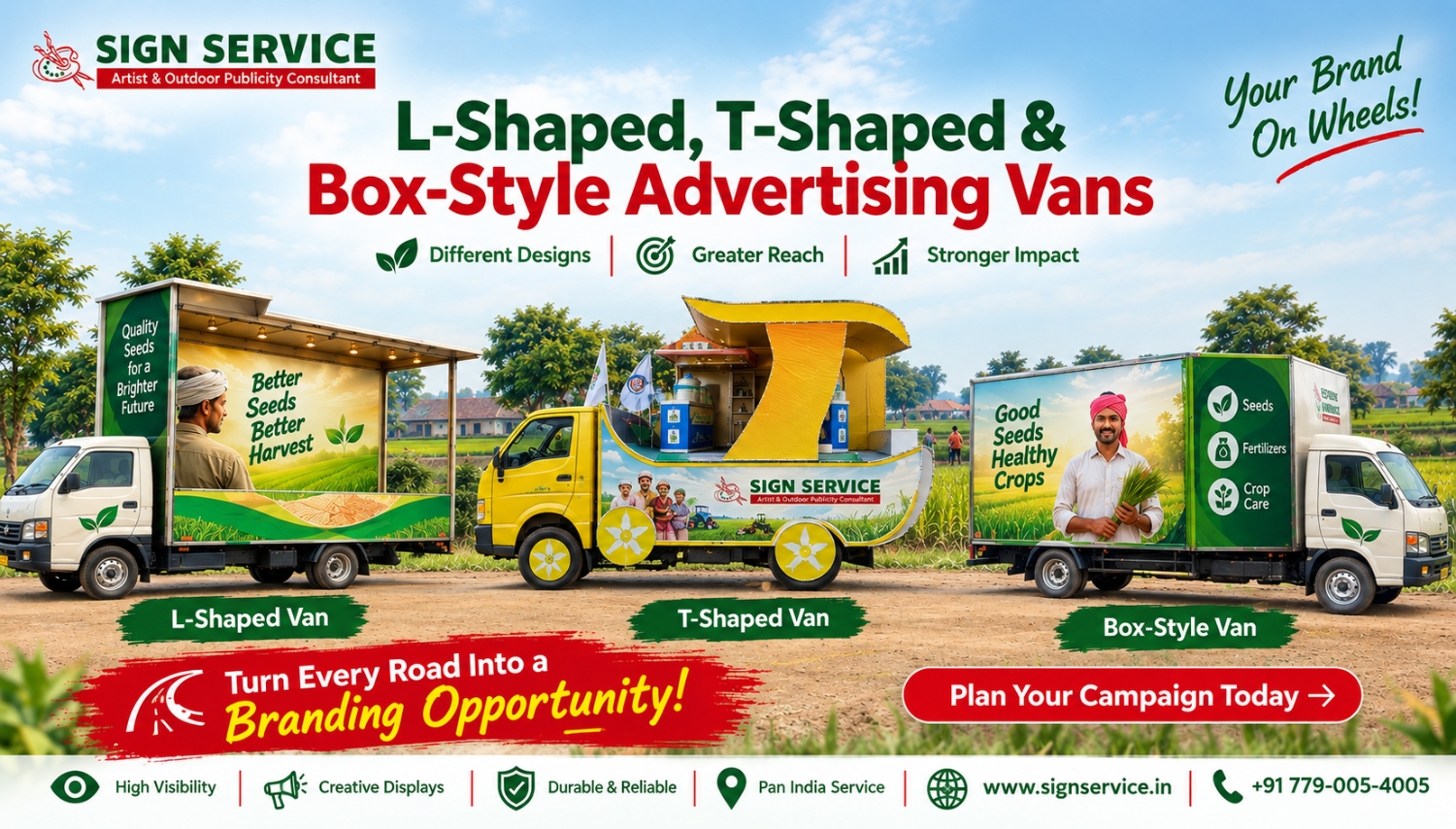
L-Shaped, T-Shaped, and Box-Style Advertising Vans: Cost Factors & Configuration Choices
 Admin / Sign Service
- 13-Oct-2026 06:35 PM
In India Mobile Van Campaign provides businesses some flexible way to promote products, demonstrate services, and engage audiences beyond conventional fixed locations. Mobile van campaigns play a major role in bringing promotional content directly to different markets whether from product demonstrations and road shows to normal promotion and brand activation.
The most important part of campaign planning is choosing the right vehicle configuration. L-shaped, T-shaped, and box-style advertising vans are different in their structural design, display placement, equipment integration, and available space. Understanding these differences helps businesses evaluate which fabrication requires, what should be estimated costs, and according to this they can select a setup that suits their campaign objectives.
Different Types of Advertising Vans and Their Applications
1. L-Shaped Advertising Vans
L-shaped vans use a custom L-Shaped layout that should be built around the vehicle’s frame, made specifically to what your campaign needs. This design gives you a clean balance of space for graphics, display equipment, and interactive setups.
-
Best used for: Product demonstrations, local promotions, sampling activities, and roadshows.
-
Key considerations: Display positioning, structural support, vehicle capacity, equipment access, and weight distribution.
2. T-Shaped Advertising Vans
A T-shaped advertising van campaign should be displayed from multiple directions. It can attract people easier whether they’re walking toward you, past you, or seeing you from across the street.
-
Best used for: Promotional roadshows, public activations, and campaigns requiring directional visibility.
-
Key considerations: Overall height and width, structural stability, mounting arrangements, route clearance, and wind exposure.
3. Box-Style Advertising Vans
The box-style van is another way of a mobile showroom on wheels. The closed body gives plenty of space for high-impact branding or digital screens, while protecting its equipment, stock, or interactive technology you have inside the van.
-
Best used for: Travelling exhibitions, mobile showrooms, product demonstrations, and equipment-intensive promotions.
-
Key considerations: Internal space, ventilation, electrical systems, loading capacity, accessibility, and total vehicle weight.
L-Shaped vs. T-Shaped vs. Box-Style Advertising Vans
|
Feature |
L-shaped van |
T-shaped van |
Box-style van |
|
Structure |
L-shaped arrangement |
T-shaped arrangement |
Enclosed or box-shaped body |
|
Display planning |
Based on layout and viewing direction |
Based on display orientation |
Exterior and optional interior displays |
|
Space utilisation |
Depends on the frame design |
Depends on the frame design |
Can include enclosed storage or working space |
|
Fabrication focus |
Frame and mounting support |
Structural balance and mounting |
Body construction and internal fit-out |
|
Main cost factors |
Structure, displays, installation |
Structure, displays, installation |
Body fabrication, equipment, and fit-out |
Which configuration is best? The answer depends on the purpose of the campaign, vehicle compatibility, display requirements, operating locations, and available budget. No single design is automatically the most cost-effective for every application.
What Determines Mobile Advertising Van Cost in India?
The cost of an advertising van in India is determined by several factors, including the chosen vehicle, fabrication, display, and equipment types and sizes. A simple branded van will not cost the same as one with speakers, displays, and other equipment. It is essential to understand the breakdown when comparing offers and setting the budget.
1. Vehicle Selection and Preparation
It is necessary to choose the vehicle and prepare it for modifications. The price depends on the category, engine, carrying capacity, and fuel type. Some companies buy a new vehicle, while others modify an existing one. If the company already has the suitable vehicle, it saves on the purchase but may have to spend money on preparing the chosen vehicle for fabrication. The preparation process also depends on the selected vehicle category and includes technical inspection, repairs, and other work. By selecting the appropriate vehicle, the company can avoid additional expenses due to incorrect modifications.
2. Mobile Advertising Van Fabrication
The selected vehicle should have enough space for displays and other equipment. The next step is to fabricate the van, which includes technical drawings, mounting mechanisms, bodywork, and other modifications. The cost of van fabrication depends on the materials, design, and complexity of the modifications.
The van can be equipped with simple advertising displays and special structures for road shows, product promotions, and other activities. A promotional van with billboards usually does not have complex constructions, while a van for roadshows and fairs requires more effort and resources for installation. The fabricators must also consider the material strength and other characteristics so that the van equipment is reliable under regular use and is safe for the vehicle itself. The correct approach to fabrication reduces the risks of breakdowns and allows maintaining the vehicle’s good condition.
3. LED Screens Vs. Static Branding
The company must also select the type of displays for the advertising van. Some organizations are looking for ways to make their ads more noticeable, so they choose special constructions with screens that show videos. In contrast, some companies are satisfied with static display banners. In any case, the chosen structure affects the final cost of the van.
LED displays have specific technical specifications, such as matrix size, pixel pitch, brightness, and protection class. The cost depends on the screen size, and equipment with a large surface requires more powerful hardware to work properly. The display must also have sufficient protection so that the advertising van can operate outdoors under various weather conditions. Special lighting solutions may also be required for specific locations or time zones, such as night-time operation.
In comparison, static display banners usually do not require complex equipment, but the choice of materials, print quality, and banner mounting also affect the van modification cost. It is also essential to consider the place and manner in which the van will be used because static banners may not be effective in some cases.
4. Power Supply, Equipment, and Air Conditioning
Vans with LED displays, special screens, or other equipment require an additional power supply. Depending on the selected equipment, it may be necessary to install a generator, batteries, an inverter, and other components. Vehicles with air conditioning or special ventilation are also more expensive.
Mobile showrooms and other vans with displays and equipment need proper ventilation so that the technology does not overheat during prolonged operation. Therefore, the company should calculate the required power supply and equipment for the advertising van so that all systems work correctly and do not fail during operation. In addition, the company should count on the daily operating time of the van and its equipment.
5. Installation, Testing, and Other Requirements
Before putting the vehicle into operation, it is necessary to install and commission the equipment and check all connections for security and reliability. The installation and commissioning of equipment also affect the final cost of the advertising van.
Moreover, the company should study the requirements for advertising vehicles in the region in which the van will travel. These requirements may include technical inspections, vehicle documentation, special permits for advertising, parking rules, and other regulations. These restrictions differ depending on the location and must be taken into account.
How to Choose the Right Advertising Van Configuration
Use these steps to evaluate your options:
1. Define the campaign objective: Identify whether you need product demonstrations, digital displays, roadshows, or a mobile showroom.
2. Assess display requirements: Decide on screen size, graphic coverage, viewing direction, and equipment placement.
3. Check route conditions: Consider road access, height restrictions, turning space, parking, and event locations.
4. Evaluate vehicle capacity: Ensure the vehicle can accommodate the structure and equipment safely.
5. Estimate total costs: Include fabrication, displays, branding, installation, power systems, and ongoing maintenance.
6. Plan for servicing: Ensure key equipment and control systems remain accessible for inspection and repair.
These considerations help businesses select an advertising van configuration based on practical requirements rather than appearance alone.
How to Compare Mobile Advertising Van Quotations
Before choosing a supplier, request an itemised quotation that clearly identifies the work and equipment included.
Check for:
- Vehicle supply or preparation, where applicable.
- Fabrication materials, structural work, and finishing.
- LED screen specifications or printed branding materials.
- Power systems and audio-visual equipment.
- Installation, testing, and commissioning.
- Warranty coverage, maintenance terms, taxes, and exclusions.
Compare quotations with equivalent specifications. A lower initial price may not represent better value if important equipment, installation work, or after-sales support is excluded.
Plan Your Mobile Van Advertising Campaign with Sign Service
Selecting the right advertising van involves balancing vehicle compatibility, fabrication requirements, display technology, branding, and budget.
Sign Service Ad Agency Pvt. Ltd. provides outdoor advertising and branding solutions for businesses planning promotional campaigns. Discuss your requirements, preferred configuration, and intended application to establish the appropriate project scope.
Planning a mobile van advertising campaign? Contact Sign Service to discuss your requirements.
FAQs
Q1. What is the difference between L-shaped, T-shaped, and box-style advertising vans?
L-shaped and T-shaped vans use different structural layouts, while box-style vans generally feature an enclosed body. Each design offers different options for display placement, equipment integration, and space utilisation.
Q2. What affects mobile advertising van cost in India?
The cost depends on the vehicle, fabrication, LED displays, branding materials, power systems, installation, and maintenance requirements.
Q3. Is a mobile LED advertising van suitable for outdoor promotions?
Yes. It can support roadshows, product launches, and promotional events. Screen visibility, power requirements, weather protection, and operating conditions should be assessed.
Q4. What is involved in mobile advertising van fabrication?
Fabrication may include structural design, framework construction, body panels, display mounting, electrical integration, and exterior branding.
Q5. How do I choose the right advertising van configuration?
Consider your campaign objectives, display requirements, vehicle capacity, operating locations, safety requirements, and overall budget.
Q6. What should I check before accepting an advertising van quotation?
Review the fabrication scope, equipment specifications, branding, installation, testing, warranty, maintenance, and any excluded costs.
Q7. How can I contact Sign Service for mobile van advertising?
Contact Sign Service Ad Agency Pvt. Ltd. at +91 779-005-4005 or sales@signservice.in to discuss your campaign requirements.
© 2026 Sign Service. All Rights Reserved
Designed and Developed by Pink Shadow Media & Entertainment Pvt. Ltd.